


Join Us
IITC brings together industry and academic experts to present leading research on BEOL and MOL interconnects, including materials, unit processes, integration, reliability, and emerging 2.5D/3D and heterogeneous architectures. The conference serves as a key forum for discussing interconnect challenges and solutions at the most advanced technology nodes.
Poster Presentations
Wednesday, June 3rd, 5:30 pm – 7:30 pm
Integration Learning to Enable Mo as the Next Generation Contact Metal
Na Zhang, Director, R&D - ICPS, Entegris
Kyle Blakeney and Ben Natinsky, Lam Research
This poster examines how molybdenum films deposited using different precursors, methods, and stack architectures influence downstream CMP performance. Experimental results show that, despite large variations in film microstructure and crystal orientation, optimized Mo CMP slurry chemistry delivers comparable removal rates across all films. The work demonstrates that CMP robustness can decouple deposition constraints, enabling greater flexibility in Mo contact integration at advanced nodes.
Wednesday, June 3rd, 5:30 pm – 7:30 pm
Accelerating Low Resistivity Metal Precursor Development Through Molecular Modeling
TA Yeh, Senior Principal Engineer, Advanced Technology Engagement, Entegris
This poster presents a combined experimental and density functional theory (DFT) study of low temperature, oxygen free ALD Ru deposition with inherent selectivity. Substrate dependent nucleation behavior on TiN, SiN, and SiO₂ is correlated with computed reaction energies for ligand removal and surface stabilization. Attendees will see how molecular modeling can predict selectivity trends and accelerate precursor screening for advanced interconnect metals.
Wednesday, June 3rd, 5:30 pm – 7:30 pm
Dielectric Constant and Etch Resistance of Al₂O₃ and HfO₂ Etch Stop Layers
Jimmy Huang, Scientist II, Modeling and Simulation, Entegris
This work investigates the tradeoffs between electrical performance and etch resistance in advanced ESL stacks using SiOC combined with Al₂O₃ or HfO₂. DFT calculations quantify changes in effective dielectric constant due to interfacial bonding, while machine learning enabled molecular dynamics simulations compare fluorination mechanisms and etch rates under CF₃ exposure. HfO2 offers 2X improvement in etch selectivity, albeit with a higher capacitance.
Event Related Content
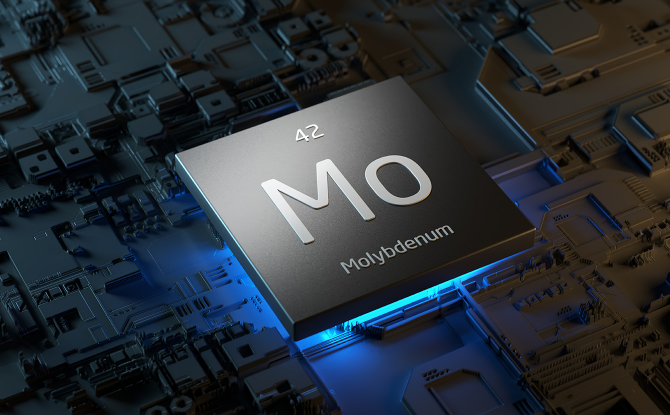
Molybdenum, the Precursor Revolutionizing Semiconductor Manufacturing
As advanced logic and memory devices push toward smaller dimensions and higher performance, the semiconductor industry is adopting new, lower resistance metals like molybdenum (Mo) as a next generation standard. With more than 20 years of expertise, Entegris delivers a full portfolio of high purity Mo precursors, delivery systems, coatings, and cabinets to enable reliable integration into advanced device manufacturing.