


Interface Integrity
Managing interface integrity is a recipe for predictable yield, scalable manufacturing, and reliable deployment of advanced packaging architectures.

Interface integrity defines yield in advanced packaging, governing how surfaces, materials, and processes interact to determine performance and reliability. As architectures move toward hybrid bonding, high density RDL, and panel level integration, interfaces are created once and carried through multiple stresses with no opportunity for repair.
In this environment, nanoscale contamination, surface variation, or marginal process conditions can become permanent defects, often originating upstream but appearing later at bonding, test, or in the field. This disconnect makes yield loss difficult to isolate and increasingly costly, particularly as AI and HPC applications concentrate more value in each package.
Interface integrity provides a system level framework to understand and control how variation accumulates across the integration flow. By addressing key domains including substrate handling, materials delivery, CMP, plating, bonding, electrostatic control, and contamination management, manufacturers can reduce variability, improve yield predictability, and scale advanced packaging reliably.
Collaborating to Solve Advanced Packaging Substrate Challenges
Explore how collaboration is solving advanced packaging substrate challenges by accelerating innovation in materials, processes, and supply chain performance to support next generation semiconductor technologies.
Featured White Paper
Interface Integrity: The Yield-Defining Discipline in Advanced Packaging
Advanced packaging performance is increasingly defined by what happens at the interfaces formed throughout the integration flow. This white paper introduces Interface integrity as a framework for understanding how surface conditions, materials interaction, and process variation accumulate and carry forward to impact yield and long term reliability.
-
We only see these failures at final test or after bonding. What could be driving that?
In many cases, the interface was affected earlier in the process. The impact often does not become visible until the interface is stressed during bonding or testing, even though the original condition may be several steps upstream.
-
Yield still varies even when individual steps look in control. Why is it so hard to isolate the root cause?
Interface-related variation rarely comes from a single source. Small differences across handling, materials, and processing steps can combine and carry forward, making it difficult to trace a failure back to one specific condition or tool.
-
We are seeing front end–level contamination sensitivity in packaging processes. What is changing?
As interconnect density increases, interfaces become sensitive to very small levels of contamination and surface variation. Effects that were once limited to front end processes are now influencing yield in packaging, but without the same opportunity for rework or correction.
-
What changes once an interface is formed, and why is it difficult to recover from defects after that point?
Interfaces are typically created once and then carried through the rest of the process. If they are formed under marginal conditions, there is often no way to repair them. Any particles, residues, or voids present at that point become part of the final structure.
-
What changes when substrates get larger, thinner, or more complex?
Larger and thinner substrates are more sensitive to mechanical stress, warpage, and non‑uniform processing conditions. These effects can alter alignment and surface quality before bonding, which directly impacts downstream yield.
-
Where do voids or defects in underfill, mold, or other high‑viscosity materials typically originate?
High‑viscosity materials require higher pressure and shear during dispense, which can introduce microbubbles or incomplete wetting. These defects may remain embedded and only become active later under thermal or mechanical stress.
-
How can the same material behave differently across tools or setups?
Material performance depends on the full delivery system. Flow rate, pressure, dispense geometry, and filtration all influence how the material moves and interacts, so small differences in setup can lead to variation in results.
-
What makes bonding so sensitive to small surface differences?
Bonding depends on surface planarity and cleanliness at very small scales. Even minor topography variation or residual contamination can prevent full contact, leading to incomplete bonds or voids.
-
What role does CMP play in hybrid bonding yield?
CMP defines the planarity and cleanliness of the surfaces that are later bonded. In hybrid bonding, even small variations in surface topography or residual contamination can prevent full contact, leading to voids or incomplete bonds. Because these interfaces cannot be reworked after bonding, the surface condition established during CMP becomes a critical determinant of bonding success and overall yield.
-
Some interface issues appear inconsistent or hard to reproduce. What contributes to that?
Interfaces are influenced by multiple factors, including contamination, electrostatic charge, handling, and environmental exposure. These conditions can vary over time and across the flow, which can make certain issues appear intermittent.
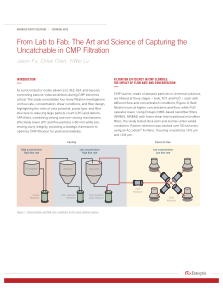
Capturing the Uncatchable in CMP Filtration
Examine a series of controlled studies that explore how CMP performance is shaped by the interaction of slurry chemistry, particle behavior, flow conditions, pump selection, and filter design. This technical note walks through how shear forces, agglomeration, electrostatic effects, and system configuration influence particle populations over time and across different process conditions.

Explore how advanced materials, contamination control, and precision process solutions come together across the advanced packaging manufacturing flow to solve yield, performance, and reliability challenges.